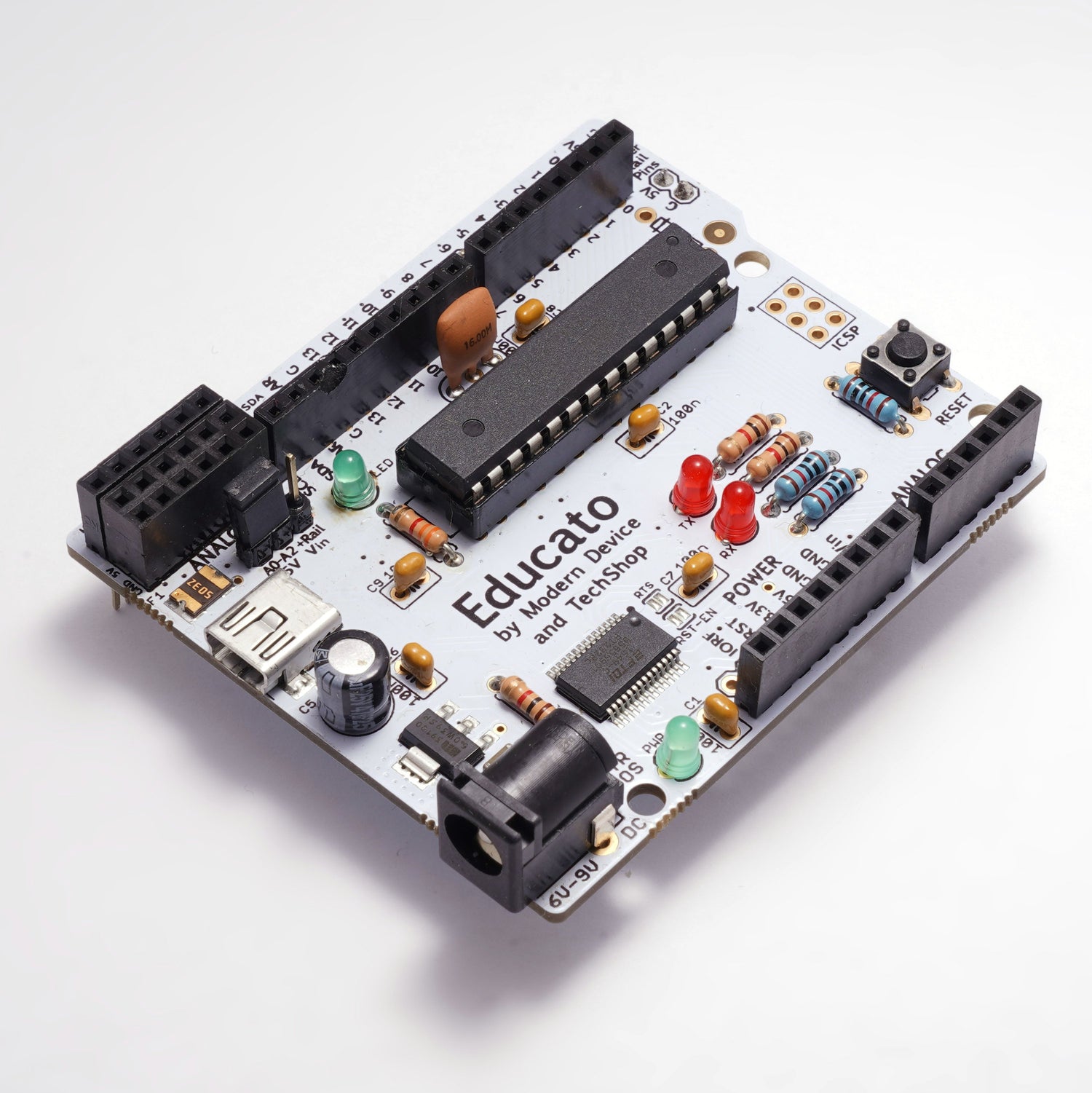
Bare Bones BoardThe Bare Bones Board is an Arduino-compatible board (Freeduino) that implements the functionality of the Arduino Diecimila, on a smaller printed circuit board, by removing the USB communications chip to a cable. More on this below. It is completely compatible with the Arduino project software and IDE. Currently the Bare Bones Board is listed on the Arduino site as "Recommended Third-Party Hardware". It has also gained a devoted following among Arduino users, as simple, effective, low-cost hardware. Arduino is an open-source microcontroller hardware, and software, environment, closely related to the Wiring and Processing open-source initiatives. The microcontroller uses an Atmel Atmega168 chip programmed with a bootloader, so no dedicated programming hardware is required. The free software IDE has been developed in tandem with the Processing and Wiring initiatives and customized for the Arduino environment. Arduino is programmed in the "C" programming language, with an integrated development environment (IDE) engineered for beginning programmers. The language includes support for desirable microcontroller features such as 32 bit and floating point math and many standard C libraries. Projects that outgrow the Bare-Bones Board's capabilities can easily be ported to the Wiring Board, which is based on the Atmega128 chip. |
||||||||||||||||||||||||||
| Atmega168 features, upon which the BBB is based: 14k flash program storage |
Totally Open Arduino-Compatible Hardware Development
Currently shipping revision is Rev. D |
|||||||||||||||||||||||||
|
Instructions for Bare-Bones Board Rev. C & D |
The Bare-Bones BoardThe Bare-Bones Board was engineered to be a low-cost, breadboard-friendly Arduino-compatible especially useful for education. The USB communications chip has been removed to a cable which you only need purchase once. This has several advantages. • It saves the cost of repeatedly paying for the communications chip. • It makes the board 1/3 smaller in both dimensions than the Arduino® NG board. • Designed with all through-hole parts for easy assembly by beginners. • Using the cable makes it simple to embed "Arduino-compatibility" unto other boards, see the Servo project for an example. The board was specifically designed to work with a FTDI TTL-232R USB-to-TTL serial cable, available below. The FTDI cable is also a handy way to debug lots of other microcontroller serial connections and will work anywhere you need a solid USB to TTL serial connection. A low-cost (<$5.00) serial adapter is also available for those wishing to use an RS232 port. See the Connect page.
|
|||||||||||||||||||||||||
|
BBB Features:Despite the Bare-Bones name, the BBB is a full featured Arduino-compatible that includes the vast majority of the functionality of the Arduino Diecimila. The BBB even includes some analog noise-reduction features not found on other official Arduino boards. Breadboard-friendly options on the BBB are also not found on other official Arduino boards. • Auto-reset and "Diecimila" bootloader for "one-click" uploads and faster times to get to the sketch. Software chip resets. • Designed with male header pins on bottom to insert directly into solderless breadboards, saving a lot of wiring and fuss. • Analog inputs have adjacent +5V and Ground buses to make interfacing sensors easy, using a three pin female header. Quick and easy for interfacing servos or our serial 117 LCD controller. • Flexible power options USB/External, onboard voltage regulator that can be used with either TO92 or TO220 voltage regulators. • Convenient pins to power, (or draw power from) breadboard power buses, a shunt allows easy switching between options. Revision DThe latest revision, Rev. D, added only one capacitor and one header pin (reset) to the board to implement the "one-click" upload scheme now used on the Diecimila, and future official Arduino boards. In Rev. C, an inductor and capacitor were added across the AVCC pin. This is recommended in the Atmega datasheet but not included in most other Arduino implementations. Some hole sizes were changed in the name of easier assembly, and the analog pins were moved over to accommodate readily available commercial connectors. Older Rev. B and Rev. C photos and instructions can be found here.
|
|
|||||||||||||||||||||||||
Programmed Atmega168 Chips:• Programmed with Diecimila bootloader for latest Arduino/Freeduino implementations. • For replacement of older Arduino's Atmega8 chips or building your own Bare-Bones Board, or breadboard Arduino-compatibles. • Older bootloaders such as Adaboot are available on request. Please include this information in the Paypal message field when you check out.
|
|
|||||||||||||||||||||||||
|
Header pins on digital pins can be provided (or installed) in several
options: The 18 pin digital pin header can be provided with several options including: Male or female facing in either direction. Double male headers that face both up and down, and new "stacking headers" that are female on the top side of the board and male on the bottom side of the board. The 3 x 7 pin analog block can also be provided with male or female headers at the customers choice, to implement shield boards. We usually have at least 10 assembled in stock - ships in 24 hours. |
* For educational customers only, classroom packs contains one extra board, programmed Atmega168, resonator and voltage regulator. |
|||||||||||||||||||||||||
| FTDI TTL-232R USB-to-TTL serial cable. I carry these just as a convenience to my customers. I won't sell
cables unless you're buying something else here, they're available Larger quantity discounts on the Connect page. 80 in stock.
|
|
|||||||||||||||||||||||||
Here is a green, prototype, Bare-Bones Board on a breadboard. Note the two pins on the right side which power the breadboard buses. The pins in the kit can be inserted in either direction for use with either breadboards or shield boards. Note that all boards currently shipping have white solder mask, as shown above. Note also the super-easy hookup of LED's and resistors. No fussy six inch wires, no resistor rat's nest. It's just as easy to hook up 12 or 20.
|
||||||||||||||||||||||||||
Support Files and Pages
This work is licensed under a Creative Commons Attribution-Noncommercial-Share Alike 3.0 License. Instructions for Bare-Bones Board
Rev. C |
||||||||||||||||||||||||||
| This page last modified 05/13/08 | ||||||||||||||||||||||||||